

Workplace Japan 2026: New Rules, New Responsibilities
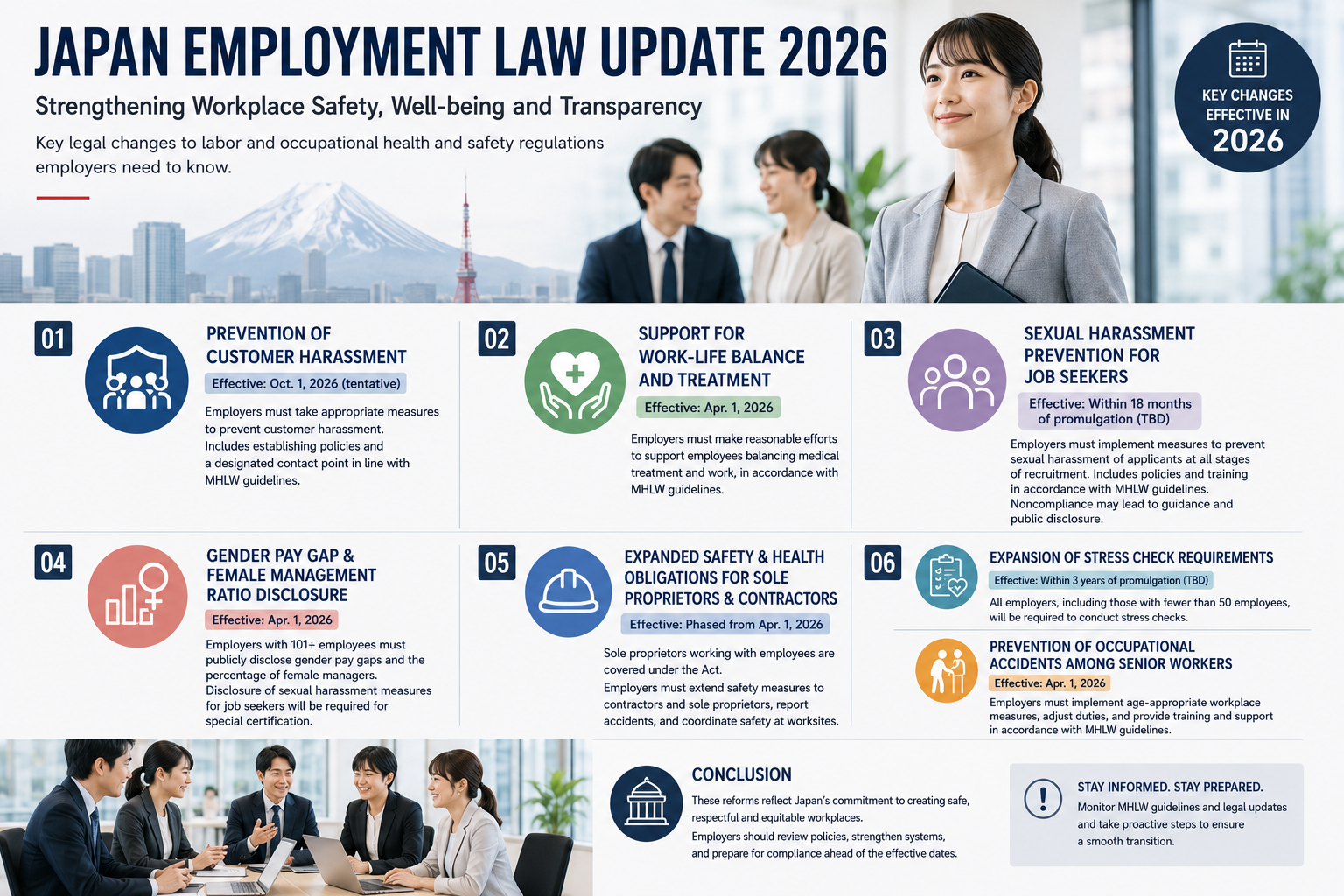
Japan Employment Law Update: Key Labor and Workplace Safety Changes for 2026
Introduction
By the end of 2026, Japan expects to implement a series of significant amendments to its labor and occupational health and safety framework. These reforms reflect an increased regulatory focus on workplace safety, employee well-being, harassment prevention, work-life balance, and transparency.
Many of the new obligations will be supplemented by forthcoming guidance from Japan’s Ministry of Health, Labour and Welfare (“MHLW”). Employers should therefore review their internal policies and compliance systems now, particularly in the areas of customer harassment, medical treatment support, recruitment practices, gender-related disclosures, and occupational health and safety.
This update summarizes several of the most significant legal developments and outlines the practical steps employers should consider in preparation.
1. Amendments to the Comprehensive Promotion of Labor Policies Act
A. Measures to Prevent Customer Harassment
Effective October 1, 2026, subject to final implementation timing, employers will be required to take appropriate measures to prevent customer harassment in the workplace.
For these purposes, customer harassment generally refers to conduct by third parties—including customers, clients, business partners, and facility users—that exceeds the bounds of socially acceptable behavior and adversely affects an employee’s working environment.
Employers will be expected to implement measures consistent with forthcoming MHLW guidelines. These measures may include:
Adopting a formal policy prohibiting customer harassment;
Establishing procedures for employees to report incidents;
Designating a point of contact for affected employees;
Training managers and frontline personnel on appropriate responses; and
Developing escalation procedures for serious or repeated misconduct.
Employers that interact regularly with customers or other external parties should begin reviewing existing harassment and complaint-handling policies to determine whether they adequately address third-party misconduct.
B. Supporting Employees Who Are Balancing Work and Medical Treatment
Beginning April 1, 2026, employers are now required to make reasonable efforts to support employees who are balancing ongoing medical treatment with their work responsibilities.
The expected framework will emphasize workplace flexibility and accommodation, with measures to be implemented in accordance with MHLW guidance.
Employers should consider whether their current leave, scheduling, remote-work, accommodation, and return-to-work policies provide sufficient flexibility for employees managing continuing medical treatment.
2. Sexual Harassment Prevention in Recruitment
Employers will also be required to adopt measures designed to prevent sexual harassment of job seekers, including students, interns, and other applicants.
These obligations are expected to apply throughout the recruitment process, including:
Interviews;
Internships;
Recruiting events;
Alumni or employee networking meetings, including OB/OG visits; and
Other pre-employment interactions.
Employers will likely be required to establish clear internal policies and provide appropriate training to employees who participate in recruiting and candidate-facing activities.
Failure to comply may result in administrative guidance and, in certain circumstances, public disclosure of noncompliance.
The effective date has not yet been finalized but is expected to fall within 18 months of promulgation of the amended legislation.
Employers should consider expanding existing anti-harassment policies so that they expressly apply to applicants and recruitment-related interactions, rather than limiting protections to current employees.
3. Gender Pay Gap and Female Management Disclosure Requirements
Effective April 1, 2026, employers with 101 or more employees face enhanced public disclosure obligations concerning workforce gender data.
Required disclosures include information concerning:
Gender pay disparities; and
The percentage of management positions held by women.
In addition, implementation of measures designed to prevent sexual harassment of job seekers will become relevant to certain special certification requirements.
Employers subject to these disclosure obligations should begin reviewing the reliability and consistency of their workforce data, particularly with respect to compensation, job classifications, management positions, and gender-related reporting.
Early preparation can help identify data gaps and reduce the risk of inconsistent or inaccurate public disclosures.
4. Amendments to the Industrial Safety and Health Act
A. Expanded Safety and Health Protections for Sole Proprietors
Amendments to the Industrial Safety and Health Act will took effect in phases beginning April 1, 2026.
Under the revised framework, sole proprietors working alongside employees will increasingly be treated both as individuals entitled to workplace safety protections and as persons subject to certain health and safety obligations.
Employers and worksite operators that engage contractors or sole proprietors will need to reassess the scope of their occupational health and safety programs.
Key changes include:
Extending certain workplace safety measures to contractors and sole proprietors;
Expanding occupational accident reporting requirements to incidents involving sole proprietors; and
Requiring greater coordination of safety measures at hazardous worksites involving multiple categories of workers.
Businesses that rely heavily on subcontractors, freelancers, or sole proprietors should review contractor-management procedures and determine whether existing safety protocols adequately address these workers.
B. Expansion of Stress Check Requirements
Japan’s statutory stress check requirements will also be expanded.
Currently, certain smaller employers are exempt from mandatory stress check requirements. Under the amended framework, employers with fewer than 50 employees will also become subject to the requirement.
Employers that have not previously maintained a formal stress check program should begin evaluating implementation options, including the use of external occupational health or service providers.
The effective date has not yet been finalized but will be established within three years of promulgation of the amended legislation.
C. Prevention of Occupational Accidents Among Senior Workers
Effective April 1, 2026, employers are now expected to make reasonable efforts to implement workplace safety measures tailored to older employees.
These measures may include:
Improving the physical work environment;
Modifying job duties or workloads where appropriate;
Addressing ergonomic or mobility-related concerns;
Providing additional training or support; and
Reviewing workplace risks that may disproportionately affect senior workers.
The measures should be implemented in accordance with forthcoming MHLW guidelines.
Employers with an aging workforce should consider incorporating age-related risk assessments into their broader occupational health and safety programs.
Conclusion
The 2026 reforms significantly expand employer responsibilities across several areas of Japanese employment law, including harassment prevention, workforce transparency, medical treatment support, recruitment practices, and occupational health and safety.
Because many of the new requirements will depend on forthcoming MHLW guidance, employers should closely monitor regulatory developments and avoid waiting until the effective dates to begin implementation.
A proactive compliance review should include:
Updating workplace harassment policies;
Reviewing recruitment and applicant-facing procedures;
Assessing work-treatment accommodation practices;
Preparing gender pay and management data;
Reviewing contractor and sole-proprietor safety protocols;
Planning for expanded stress check requirements; and
Evaluating workplace protections for senior employees.
Early preparation will help employers reduce compliance risk and implement the new requirements in a more orderly and effective manner.
This update is provided for general informational purposes and does not constitute legal advice.
As an international lawyer and consultant for over 25 years, Dr. Heath Havey advises employers on compliance with Japanese employment laws. If you have questions of employment compliance, please contact Japan Employment Solutions K.K. at contact@japan-employment.com
Disclaimer: Japan Employment Solutions K.K. is a legal solutions, practical compliance and consulting company. It is not a law firm and does not engage in the practice of law. Japan Employment Solutions K.K. does not provide legal advice.