

The Job Interview Is Now Part of Japan's Harassment Compliance Framework
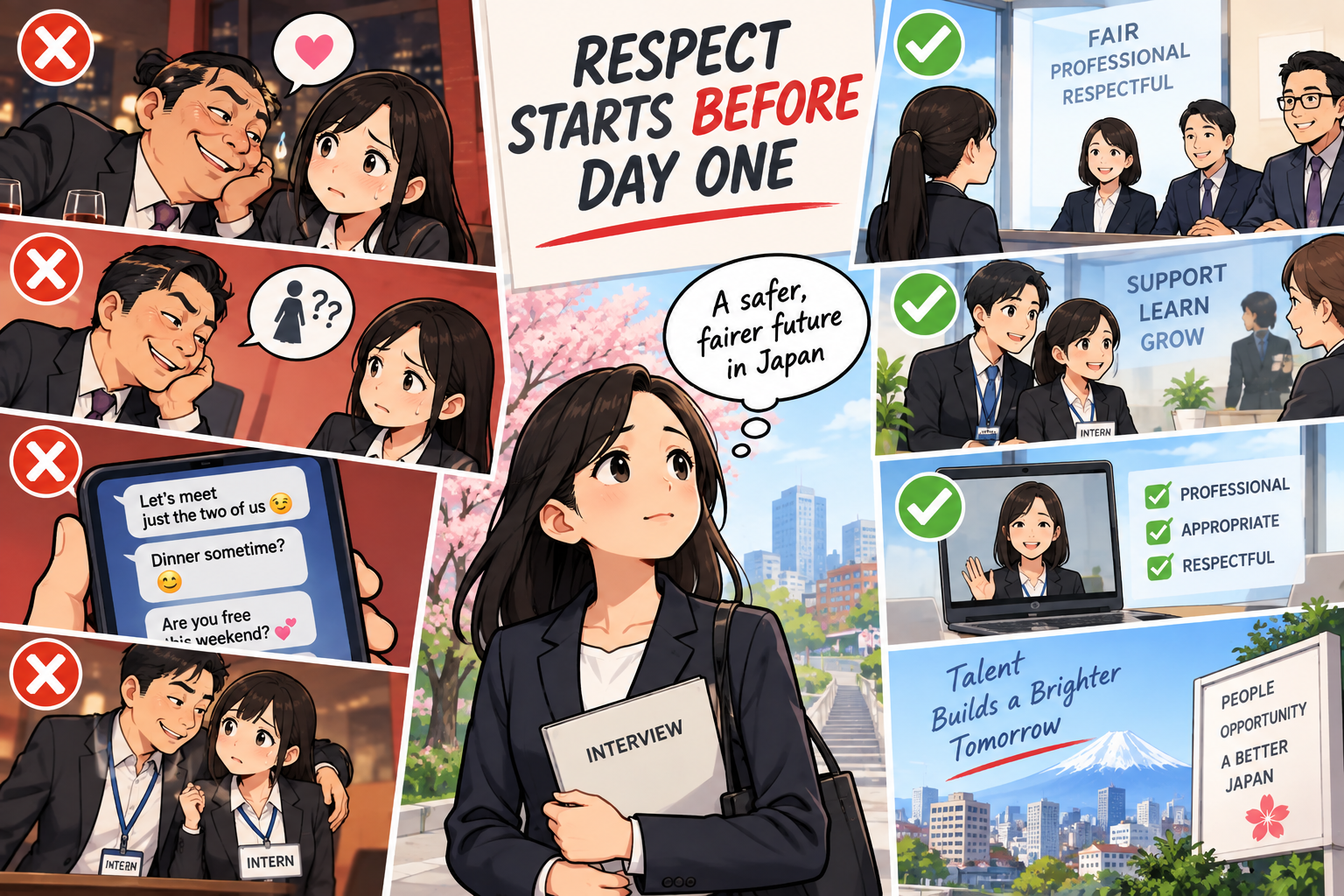
Most companies understand that their harassment policies apply to employees. Beginning October 1, 2026, companies operating in Japan will need to pay much closer attention to people who do not work for them yet—and may never work for them at all.
Amendments to Japan's Equal Employment Opportunity Act will require employers to take measures to prevent sexual harassment of job seekers and others participating in employment-related activities.
This is more than a rule about inappropriate questions during an interview. It potentially changes the compliance framework surrounding the entire recruiting process.
For international employers in Japan, now is the time to ask a simple question:
Does our harassment-prevention program begin too late?
Protection Begins Before Employment Starts—or is Offered
Traditionally, companies tend to think about harassment compliance in terms of the employment relationship. Employees receive harassment training. Managers receive additional training. The employee handbook prohibits harassment. HR maintains a complaint procedure.
But what about the candidate sitting across the table from the hiring manager?
Or the university student participating in an internship?
Or the applicant having dinner with several employees after an interview?
Beginning October 1, the employer's compliance obligations expressly extend into this pre-employment territory.
The new rules cover sexual harassment of "job seekers and others" engaged in activities related to seeking employment or choosing an occupation. This includes not only conventional job applicants, but participants in job fairs, internships and certain educational or professional practicums. It can also include students meeting company employees through alumni visits.
The rules are not limited to activity occurring inside the company's office. Online and SNS communications can fall within their scope, as can interactions occurring at restaurants and other locations away from the employee's usual workplace.
That breadth is important.
A company's recruiting process does not stop being a company activity simply because everyone has left the conference room.
Why Did Japan Make This Change?
The government's own research illustrates the problem.
According to a Ministry of Health, Labour and Welfare survey cited in its 2026 guidance, 31.9% of surveyed men and women who had conducted job-hunting activities after graduating during fiscal years 2020–2022 reported experiencing sexual harassment during their job search, excluding internships.
Among the reported conduct were persistent invitations to meals or dates, sexual jokes or teasing, questions about sexual matters and unnecessary physical contact.
The consequences went beyond embarrassment. Respondents reported losing motivation to continue job hunting, experiencing anger and anxiety, having difficulty sleeping and, in some cases, requiring medical treatment.
The imbalance of power inherent in recruiting makes this problem particularly significant. A candidate may understandably hesitate to object to inappropriate conduct by someone who appears to have influence over whether the candidate receives a job offer.
A candidate may smile politely at an inappropriate joke.
That does not necessarily mean the joke was welcome.
It Isn't Just About the Interview
This may be the most important practical point for international employers.
Imagine that an interview itself is entirely professional.
Afterward, however, a manager invites a candidate to dinner. The conversation becomes increasingly personal. The manager asks about the candidate's dating life and repeatedly suggests that the two meet socially.
Or imagine an intern working closely with an employee who begins sending personal messages through LINE or another messaging platform.
Or a university student contacts an alumnus working for the company to learn more about a career there, and the employee turns the meeting into something resembling a date.
Employers should not assume these situations fall outside the new framework simply because they occurred after hours, outside the office or through a personal device.
Japan's official guidance specifically recognizes that covered activity can occur online or through social media and can take place somewhere other than the employee's ordinary workplace.
What Must Employers Do?
The new rules require more than simply adding the words "job applicants" to an existing harassment policy.
Employers must establish and communicate a policy prohibiting sexual harassment of job seekers and make clear that violations will be addressed appropriately.
Companies also need to establish rules governing recruitment-related interactions. Government guidance specifically identifies such matters as the time and place of meetings, how meetings are conducted, and which forms of SNS communication may be used.
That presents an excellent opportunity for employers to establish practical guardrails.
For example, should individual employees communicate with candidates through personal social-media accounts? When are one-on-one meetings appropriate? Are there rules governing recruiting dinners? Who should participate in interviews? What should employees do if an applicant initiates personal communications?
These questions are easier to answer before something happens.
Candidates Need Somewhere to Complain
Another potentially overlooked requirement is the complaint process.
Employers must establish a consultation mechanism for job seekers experiencing sexual harassment and make candidates aware that it exists. The personnel receiving complaints must also be prepared to respond appropriately.
This may require some employers to rethink existing reporting systems.
An internal hotline accessible only through the employee intranet obviously does little for an applicant who has never received an employee login.
Companies should therefore consider the issue from the candidate's perspective:
If something inappropriate happened during recruiting tomorrow, would the candidate know whom to contact?
A Complaint Cannot Simply Disappear Because the Candidate Wasn't Hired
When a complaint is received, employers must act.
The new framework requires employers to investigate the facts promptly and accurately. If harassment is confirmed, appropriate measures must be taken concerning both the affected job seeker and the person responsible for the conduct. Employers must also implement measures designed to prevent recurrence.
Privacy protections must also be established.
In other words, "the applicant doesn't work here" is not a reason to put the complaint aside.
The company still has a compliance problem.
Don't Forget Interns
Internships deserve particular attention.
Interns can occupy an unusual position within an organization. They may work alongside employees and report to managers, but companies do not always treat them as part of the ordinary HR compliance structure.
That can create risk.
The government's guidance expressly includes internships within the activities covered by the new framework and even uses inappropriate conduct during internships as an example of the behavior the rules are intended to address.
Companies with internship programs should therefore examine whether the employees supervising interns understand that interactions with interns are subject to the company's harassment-prevention expectations.
The same issue can arise with educational and nursing practicums and similar programs.
International Companies Should Look Beyond the Global Policy
Multinational employers often already have sophisticated global anti-harassment policies.
That is a good starting point—but it should not automatically be assumed to satisfy the new Japanese requirements.
A global policy may be written principally around "employees" and the "workplace." A reporting system may be designed for current employees. Training materials may focus on interactions among coworkers and managers.
Japan's new rules require employers to think more broadly.
The relevant universe can now include applicants, students, interns and others who may never become employees.
And the relevant "workplace" may effectively include the interview room, a restaurant, an internship site, an alumni meeting, an online interview and even certain SNS exchanges.
Five Questions Employers Should Ask Before October 1
With the effective date approaching, companies operating in Japan should consider at least the following:
1. Does our harassment policy expressly address job seekers and other covered participants?
2. Have recruiters, hiring managers and employees participating in interviews been trained on the new requirements?
3. Have we established reasonable rules for interviews, recruiting dinners, internships, alumni contacts and electronic communications with candidates?
4. Can an applicant or intern actually access our harassment reporting system—and do candidates know that the system exists?
5. Do HR personnel know how to investigate and respond to a complaint from someone who is not an employee?
If the answer to any of these questions is "we're not sure," October 1 is closer than it may seem.
Recruiting Is Now Part of the Compliance System
There is also a broader lesson in Japan's new rules.
Companies often think of recruiting primarily as a talent-acquisition function. Employment-law compliance begins after the offer is accepted.
That dividing line is becoming increasingly artificial.
The person conducting an interview is representing the company. So is the manager taking a candidate to dinner. So is the employee meeting a university student interested in joining the company. So is the supervisor overseeing an intern.
Those interactions can affect the company's reputation, its ability to attract talented employees—and, beginning October 1, its compliance obligations under Japanese law.
A good hiring process therefore needs to do more than identify the right candidate.
It should protect candidates and the company before the employment relationship even begins.
Japan Koyo Solutions helps international employers translate Japanese employment-law requirements into practical HR policies, training and procedures. If your organization has employees, applicants or internship programs in Japan and has not yet reviewed its recruiting and harassment procedures for the October 1, 2026 changes, now is an appropriate time to do so.
For more information, visit Japan Koyo Solutions at japan-employment.com.
This article provides general information regarding Japanese employment practices and is not intended as legal advice.