

Will AI Disrupt Japanese Lawyers More Than American Lawyers?
By: Heath A. Havey J.D. · Japan Employment Solutions
Here is a prediction that may make some readers uncomfortable: artificial intelligence may disrupt the traditional Japanese legal profession more profoundly than it disrupts the American one.
This is not a claim about talent. It is a claim about systems—how lawyers are trained, what clients expect from them, and what they are ultimately paid to deliver. Those systems shape which parts of legal work are most exposed when a machine can do them faster and cheaper.
I have practiced law for nearly 30 years, am licensed in California and Nevada, and qualified as a foreign lawyer in Japan (gaikokuho jimu bengoshi) in 2003.. Through Japan Employment Solutions, I advise international companies operating in Japan, often alongside or after they have received advice from traditional Japanese counsel. That dual vantage point is where this observation comes from.
Two different ways of training a lawyer
American legal education has long been built around the case method. Students read appellate decisions, then face a stream of hypotheticals from the professor. What is the other side's best argument? Which single fact, if changed, would flip the outcome? Is there another way to get the client where it wants to go?
The method is imperfect, and it has plenty of critics. But it trains a habit of mind: the assumption that there is rarely only one answer, and that a lawyer's job is to map the range of possible outcomes.
Japan's path to the bar developed differently. Historically, success depended on passing an extraordinarily demanding national examination, followed by training at the Supreme Court's Legal Training and Research Institute. That training has emphasized systematic doctrinal knowledge and standardized analytical frameworks. A well-known example is yōken jijitsu—the structured analysis of the facts required to establish each element of a claim or defense. It is rigorous, precise, and highly consistent.
Japan recognized the limits of this model. The 2004 reforms introduced graduate law schools with more interactive, case-based teaching, and many Japanese law faculty now use discussion methods that would feel familiar in an American classroom. The difference between the two systems has narrowed.
Still, professional cultures change slowly. Much of Japan's practicing bar was trained under a model that prizes getting to the correct, established answer. That is a real strength. It may also be precisely the kind of work AI is learning to do.
A caveat about "civil law versus common law"
It is tempting to explain all of this by pointing out that Japan is a civil-law country, organized around codes and statutes, while the United States is a common-law country built on precedent. That distinction matters, but it is easy to overstate—especially in employment law.
Japanese employment law is one of the most judge-made areas of Japanese law. The doctrine that makes dismissals so difficult in Japan—the prohibition on abusive dismissal (kaiko ken'ran'yō)—was developed by the courts over decades before it was written into statute. It now appears in Article 16 of the Labor Contract Act, but the words of that article tell you very little on their own. Whether a dismissal is "objectively reasonable" and "socially appropriate" is answered by case law, as are the rules on unfavorable changes to work rules, reassignments, and restructuring dismissals.
So the issue is not that Japanese employment lawyers ignore cases. They know them extremely well. The issue is what is done with that knowledge: whether the case law is used to identify the single safest, established path, or to map the full range of defensible options and their risks.
"This is how Japanese companies do it"
International companies sometimes come to Japan Employment Solutions frustrated. Usually the frustration is not that their Japanese counsel's advice was legally wrong. It is that they were given only one way of doing things, often framed as: "This is how Japanese companies do it."
That answer contains useful information. Market practice in Japan is a real data point. Courts assess reasonableness partly against how employers typically behave, and employees, unions, and labor tribunals have expectations shaped by that practice.
It is also fair to recognize why conventional advice is so common. Many clients want the safest possible answer and reward counsel for providing it. Labor tribunals and courts can be unpredictable. Unions can escalate quickly, and reputational concerns in Japan are real. A lawyer who recommends the well-trodden path is often pricing in genuine risks.
But an international company operating in Japan does not necessarily need to become a clone of a traditional Japanese company. Its business model, global policies, workforce, and risk tolerance may be very different. For that company, "how Japanese companies do it" should be the starting point of the analysis, not the end of it.
The better questions are:
1. What does Japanese law actually require?
2. Are there other compliant approaches?
3. What additional risks does each approach create?
4. Are those risks acceptable given the company's objectives?
Sometimes the conventional answer is the right one. But it should be a choice, not a default.
Where AI comes in
AI is becoming remarkably good at a specific set of legal tasks: finding the applicable rules, summarizing case law, comparing documents, flagging deviations from a standard, preparing first drafts, and reproducing established analytical frameworks. These are not trivial tasks. For generations, they were a large part of what junior and mid-level lawyers were paid to do.
Japan is moving in this direction too. In 2023, the Ministry of Justice issued guidance clarifying when AI-assisted contract review services can be offered consistent with the Attorney Act, and Japanese legal-tech tools for contract review and research have grown quickly.
The implication is uncomfortable but straightforward. If a lawyer's principal value is knowing and reproducing the conventional answer, AI is coming directly for that value proposition. A structured framework applied consistently to a set of facts is exactly the kind of work these systems handle well. The more standardized the analysis, the easier it is to automate.
This is not only a Japanese problem. American legal work is being automated as well, and plenty of U.S. lawyers spend their days reproducing standard answers. But AI may expose a particular weakness in any legal culture that favors a single accepted answer over a range of options, or that equates good advice with avoiding risk rather than calibrating it.
The harder-to-replace lawyer
The lawyer AI will struggle to replace is the one who can say: "Here is the conventional approach. Here are the alternatives and their risks. Now let's determine which best accomplishes your business objectives."
That work requires judgment about a specific client's goals, appetite for risk, relationships with its employees, and global constraints. It requires knowing when the approved answer is not enough, and having the confidence to explain why.
Consider a common scenario: an international company needs to reduce its headcount in Japan. The conventional advice is often a single path. A fuller analysis lays out the options side by side.
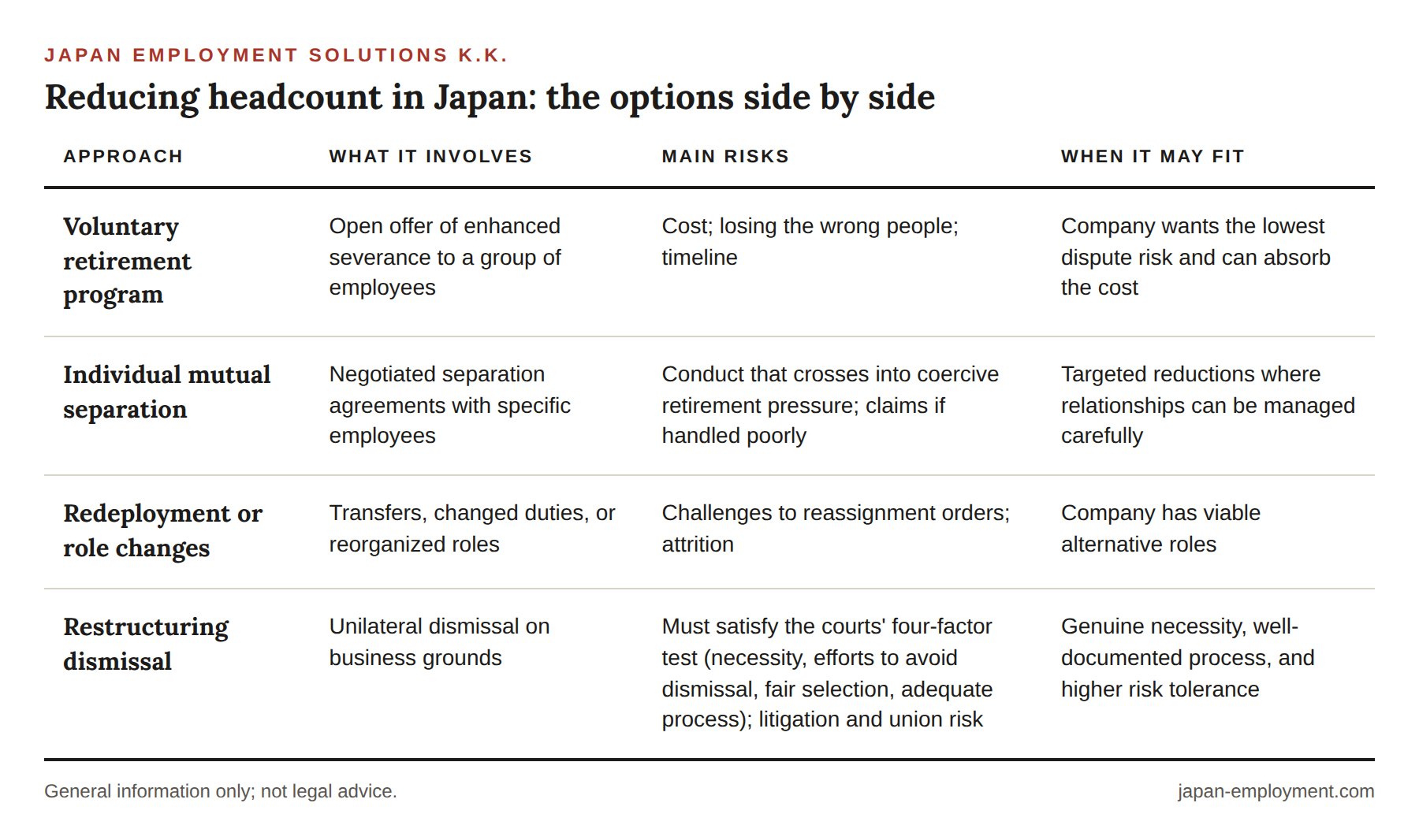
None of these is always right. The value lies in presenting them honestly, explaining how Japanese courts are likely to view each, and helping the client choose deliberately. AI can help draft the table. It cannot yet own the judgment call or the client relationship behind it.
What this means for international employers in Japan
For companies operating in Japan, the practical lesson is to ask more of legal advice, whoever provides it. When you receive a single recommendation, ask what the law strictly requires, what the alternatives are, and what risk each one carries. A good adviser should be able to answer all three.
For lawyers in both countries, the lesson is equally direct. The lawyer who always knows the approved answer may be more vulnerable to AI than the lawyer who knows when the approved answer isn't enough.
*****
At Japan Employment Solutions, that is the approach we take. We help international companies understand Japanese employment compliance issues, the range of available options and their relative risks, and practical strategies for achieving their business objectives in Japan—without unnecessarily forcing global practices into a traditional Japanese-company mold.
To discuss your company's situation, visit japan-employment.com.
This article is for general information only and is not legal advice.